Bringing Liverpool’s Waterfront Back to Life
There are times in property when you realise you are doing something that is much bigger than simply building homes. You are helping to restore a place, giving new life to an important part of a city and, in doing so, allowing people to become part of its next chapter. That is what makes Liverpool Waters so important to Romal Capital (Romal).
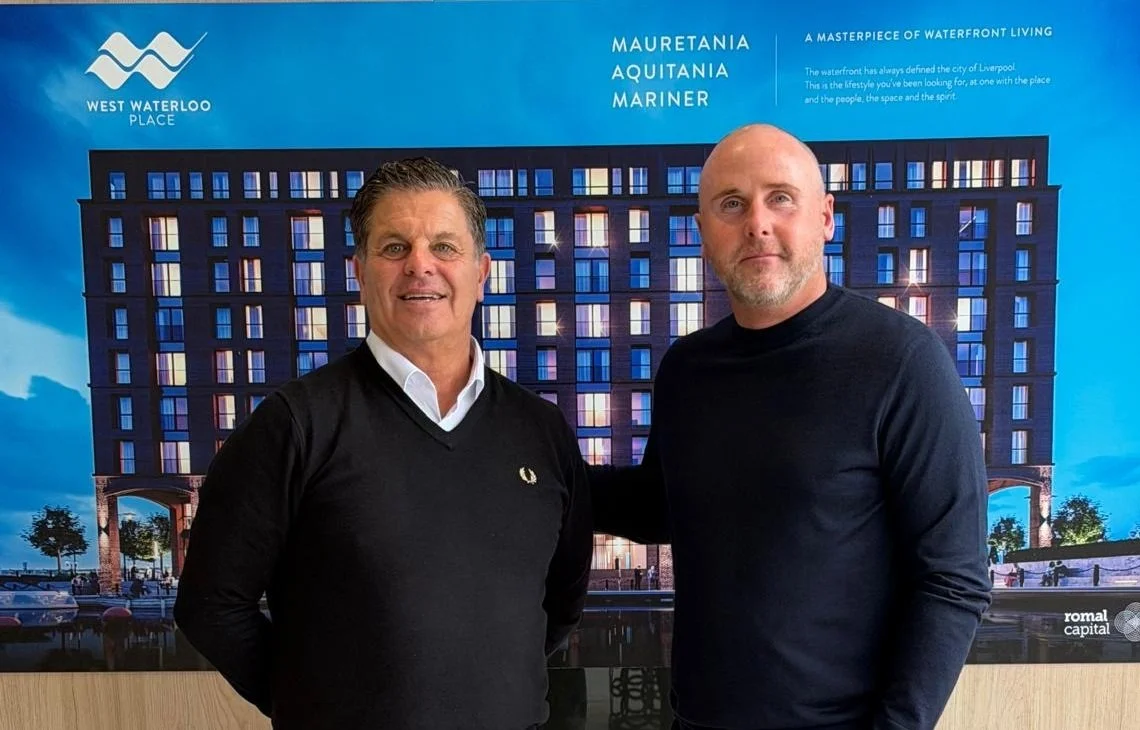
For us, this has never simply been about apartments, sales or development numbers. It has been about taking a part of one of Britain’s great cities that had, over many decades, become unused, inaccessible and largely forgotten, and helping bring it back to its former glory.
We are immensely proud to have played and are continuing to play our part in helping Liverpool recapture some of its own magnificence. Liverpool has always been a city defined by the water. Its docks, ships, trade and people created a city whose influence reached far beyond the Mersey. Yet, for decades, large parts of that extraordinary waterfront sat dormant, separated from everyday life and from the people of Liverpool.
When Liverpool Waters was given the green light in 2013, the ambition was enormous. The masterplan represented one of the largest waterfront regeneration projects in the country, covering around 60 hectares of historic dockland and envisaging thousands of new homes alongside commercial, leisure and public spaces. For Romal, the opportunity came in 2017 when we became the first private developer selected by Peel to begin development at Central Docks.
It was a significant decision. At the time, much of the area was still waiting for its future to arrive. We were stepping into a piece of Liverpool that had enormous potential, but where that potential had yet to become visible to most people. We believed in it, but we also knew that belief had to be demonstrated through delivery.
Romal’s Quay Central and Park Central became the first buildings to commence within Central Docks, followed by further developments including The Aquitania and The Mauretania. Today, hundreds of people have made their homes on the waterfront, with further phases continuing to take shape. But the most rewarding part of that journey is not the number of apartments, it is seeing the lights come on, seeing people walking beside the water, enjoying the café lifestyle amenity and watching couples, young professionals and older residents make the waterfront part of their everyday lives.
A place that had been closed off for generations has once again become somewhere people live, somewhere people walk, somewhere people meet and, most importantly, somewhere people come home. That is what bringing a waterfront back to life really means. It is also why the location has always been so powerful.
There is an old saying in property: location, location, location. It is repeated so often that it can almost lose its meaning, yet after a lifetime in property I believe it remains one of the simplest and most enduring truths. A great location gives you something that cannot easily be recreated because it so rare to find.
Liverpool Waters has the city behind it and the Mersey in front of it. It has the history of the docks, the energy of Liverpool, the growing connectivity of the waterfront and, increasingly, an extraordinary collection of places and experiences around it.
And then there is the water itself. There is something very special about coming home at the end of the day and looking across the Mersey. The light changes, the weather changes and the river changes. The sunsets are different every evening, and Liverpool has some of the most beautiful sunset of any city in the world.
You can be in the middle of a great city and, within moments of closing your front door, feel as though the rest of the world has been shut out. That combination of city, water and tranquillity is difficult to manufacture, and it is one of the reasons people have wanted to live here and it is also one of the reasons the investment story has been so compelling.
My business partner and I have seen enormous changes in the property market over the past 40 years: markets rising and falling, interest rates changing and taxation changes, along with the evolution of way people think about property.
I remember the property markets of the 1970s and 1980s, when it was possible to buy and sell relatively quickly and make substantial gains. There were periods when property values could double over relatively short periods. Those were very different times.
The world today is different. Taxes have changed the economics of short-term buying and selling. The cost of finance is different. Regulation is different. The expectations of buyers and investors are different. For us, that has reinforced a philosophy that has always been central to the way we approach property: buy to keep, rather than simply buy to sell.
That does not mean capital growth is unimportant. Of course it matters. But property becomes a very different investment when it is capable of producing an income while you own it. That is why we increasingly see the logic in thinking in the same way that many of the large corporate property investors think. They do not generally buy an asset simply because they hope to sell it next year for more money. They buy good assets in good locations, rent them, manage them properly and allow time to work in their favour.
Rental growth over the long term can be important. A well-located property can provide an income while also retaining the possibility of capital growth. And above all, there is the question of demand, because vacancy kills an investment return.
A property that nobody wants to live in is difficult to make into a successful investment, no matter how attractive the numbers may have appeared on paper. Our experience at Liverpool Waters has been that people genuinely want to live here. That is perhaps the greatest validation of the original decision.
When asked why the sales performance has been so strong, my response is: ‘We deliver what we say’. We built through Covid and delivered on time and haven’t stopped delivering since. Experience plays a big part in that, a lifetime of it.
There is something important in that statement. Property is ultimately about trust. A buyer is trusting the developer to deliver what has been promised. An investor is trusting the location to continue attracting people. A landlord is trusting that tenants will want to live there, while residents are trusting that the place they have chosen to call home will continue to be cared for.
For Romal, being on site has always been an important part of that relationship. We have always believed that our involvement should not finish when someone receives the keys. There is an ongoing responsibility to the people who live there and to the investors who have entrusted us with their property. With Romal on site, residents effectively have a “mini concierge” at a fraction of the cost. That presence matters.
It means we see what is happening, we can respond and we can negotiate with contractors and suppliers, while keeping a close eye on budgets and trying to ensure that the costs of owning and managing a property remain as sensible as possible.
Insurance, refuse management, landscaping, maintenance and security may not be the glamorous side of property development, but they are part of what makes a successful community. Over recent years, despite the extraordinary rise in the cost of almost everything around us, we have worked hard to keep increases in service costs tightly controlled. That is not something that necessarily appears in a sales brochure, but for an owner who intends to hold a property for many years, it can be just as important as the view from the balcony.
That brings us back to why we believe in buying property to keep. We do not want our purchasers thinking only about what they can sell their property for. We want them to enjoy owning it. We want the owner-occupier to enjoy coming home, the investor to have confidence that there will be people who want to rent the property, and both to feel that they have bought into somewhere with a future. Liverpool Waters is increasingly demonstrating that future.
The transformation around Central Docks is now moving at a remarkable pace. The new Isle of Man Ferry Terminal has brought another major piece of infrastructure into the waterfront. Everton’s new stadium has created another extraordinary destination on the northern docks, new walking and cycling connections are opening up the waterfront, and the wider Central Docks infrastructure programme is now bringing roads, utilities, public spaces and a major new park into the next phase of the development.
What is happening now is a continuation of something that began several years ago and that vision is becoming tangible. The northern docks are no longer simply somewhere you pass - they are becoming somewhere you go, which is an important distinction.
A great waterfront should not belong only to the people who live in the buildings beside it. It should belong to the city. The ambition to create better connections along Liverpool’s waterfront, linking communities and attractions and ultimately allowing people to experience much more of the Mersey on foot and by bicycle, is something we are particularly proud to have contributed towards. There is a wonderful sense that the waterfront is once again becoming part of Liverpool’s everyday life. And perhaps that is why the story of Liverpool Waters feels so much bigger than property.
We are not creating the Mersey. We are not creating Liverpool’s history. We are fortunate enough to be working within something that was already extraordinary and our role is to unlock it, bring it back into use, respect what was there before and give it another life: to help Liverpool rediscover something that had been sitting quietly on its doorstep for decades.
That philosophy is also at the heart of what may become our next great waterfront chapter. Brunswick Dock is one of Liverpool’s most historically important docks. Opened in 1832, it was once a place of enormous activity, with ships, steam, trade and people at the centre of its story. Like so much of the dock system, its fortunes changed over time, but now there is an opportunity to bring Brunswick Dock back to life once again.
Romal, together with its development partners, has proposed a substantial new waterfront neighbourhood incorporating hundreds of homes, public spaces, amenities and a renewed relationship with the historic dock itself. The vision is not simply to put buildings around a basin of water, it is to create somewhere that feels alive: somewhere people can live, walk, meet, exercise, eat and immerse themselves in the waterfront lifestyle; somewhere that respects the history of Brunswick Dock while giving it a new purpose for another generation.
It is still subject to the planning process, and we respect that process completely, but the ambition is clear. If Liverpool Waters has helped demonstrate what can happen when an unused piece of dockland is brought back into the life of the city, Brunswick Dock offers another opportunity to continue that story further south along the waterfront and that is what excites us most - not simply the number of homes that might eventually be built, but the possibility of continuing to restore Liverpool’s relationship with its water.
For us, this has always been about much more than property. It is about place, people and longevity, and about believing that Liverpool deserves to make the very most of one of the greatest waterfronts in the world.
After 40 years in property, I have learned that markets come and go, fashions change and investment strategies evolve. The fundamentals, however, remain remarkably constant: People want to live in places that have something special about them. They value convenience, connectivity and amenities, and they want to feel secure in the decision they have made.
For investors, there is the additional importance of having a property that people genuinely want to live or rent, supported by sensible management and costs that remain under control. Perhaps that is why the old expression about location has endured for so long. It is not simply about where a building stands on a map. It is about what surrounds it, what connects it to the wider city and what gives people a reason to want to be there.
For us, delivery and experience are simply part of that same equation. A great location only reaches its potential when somebody is prepared to invest in it, deliver properly and remain involved long after the first sale.
Liverpool has always been a city capable of extraordinary things. Its waterfront once powered a global trading city, and today we have the privilege of helping bring some of that forgotten waterfront back into the life of the city. Every evening, as the sun sets across the Mersey and the lights begin to come on along the docks, there is a sense that something remarkable is happening. A part of Liverpool that had been quiet for far too long is alive again and we are incredibly proud to be part of helping Liverpool recapture its own magnificence.
